
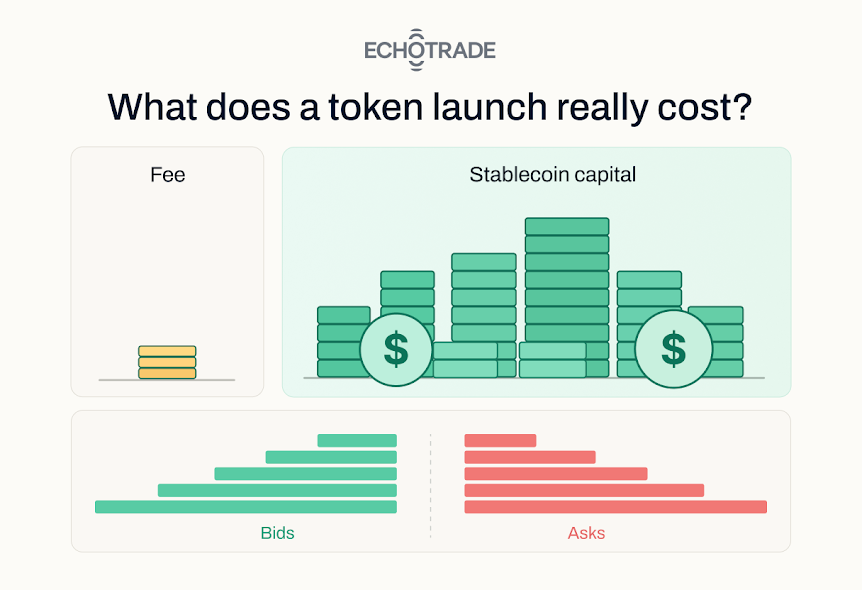
Crypto Market Making costs a token project $2,500 to $10,000 a month on a retainer, or 0.5% to 2% of token supply under a token loan. That fee is only half the bill. Someone also has to fund the stablecoin side of the order book, and that capital is usually larger than the fee.
A full token launch onto centralized exchanges, Market Making included, runs from about $20,000 to over $200,000 of spend in the first six months. A memecoin launch can be a fraction of that.
Most founders ask the second question first and the first question last. That order is the problem. The Market Making line decides how many exchanges you can support, and the number of exchanges decides most of the rest of the budget.
What does crypto Market Making cost?
Two ways to pay, and they cost very different things.
A retainer is a fixed monthly fee, typically $2,500 to $10,000. Where you land depends mostly on how many exchanges are covered and how long the contract runs. The project keeps its tokens in its own exchange accounts, and the desk trades them through API keys with withdrawals switched off.
A token loan usually has no monthly fee. Instead the desk borrows 0.5% to 2% of the token supply for 12 to 24 months and holds an option to buy those tokens at a preset price. It looks cheaper at signing. Whether it is cheaper depends on where the price is when the option comes due, which nobody can know in advance.
| Retainer | Token loan | |
|---|---|---|
| What you pay | $2,500 to $10,000 a month | 0.5% to 2% of supply, usually no fee |
| Who holds your tokens | You do. Desk trades via API keys, withdrawals disabled | The desk holds the borrowed tokens |
| Who funds the stablecoin side | The project | The desk |
| Typical term | Monthly, rolling | 12 to 24 months |
| When you know the cost | At signing | At expiry, when the option is settled |
| Fits best when | You have cash and want to keep custody | You have tokens and no cash |
Which model we use. EchoTrade operates on a retainer only. We do not take token loans, call options or profit share, and we never take custody of a project’s tokens. The loan model is described here because it is common and founders need to understand it before signing, not because we offer it.
The full ranges, and what moves a quote up or down, are in this breakdown of how much crypto Market Making costs.
Why is the stablecoin side the line founders miss?
Because the fee pays for the operator, not the order book.
Every order book has two sides. Sellers hit the bids, and the bids are made of stablecoins: USDT, USDC or whatever the pair is quoted in. Buyers lift the asks, which are made of your token. A Market Maker can only keep the spread tight and the depth stable if both sides are funded on every exchange where the token trades.
Who funds the stablecoin side depends on the deal. Under a retainer, the project does, and the stablecoins sit in the project’s own exchange accounts. It is capital rather than spend: it comes back when the engagement ends, but it cannot fund anything else while the book is live. Under a token loan, the desk brings its own stablecoins, and that is part of what the borrowed supply and the option are paying for.
On a retainer this capital is commonly $20,000 to $1M or more, depending on how many venues you cover and how deep you want the book. In most engagements it is larger than the monthly fee. A project that budgets $5,000 a month for its Market Maker and nothing for the stablecoin side has paid for a driver and forgotten the fuel.
What happens when the stablecoin side runs thin?
The book goes one-sided. Sell orders arrive, the stablecoin bids get consumed, and nothing replaces them until someone tops up the account.
In practice that shows up three ways:
- Spreads widen, because the desk has less capital to quote with near the price.
- Price drops faster than demand justifies, because each sell walks down a thinner book.
- The exchange notices. Exchanges monitor spread and depth continuously after listing. MEXC, for example, publishes that it flags tokens whose average daily spread stays above 2% for 15 consecutive days.
This is why the stablecoin budget has to be sized per exchange. Depth does not transfer between venues. $10,000 of USDT on one exchange does nothing for the book on another, and that arithmetic is what caps how many venues a project can actually support.
How much does it cost to launch a token?
Market Making is one of six lines. The others are legal and entity setup, a smart contract audit, exchange listing fees, marketing, and the order book capital described above.
Over the first six months after listing, launches tend to fall into three shapes.
Lean, around $20,000 of spend. Two mid-tier exchanges, a modest audit, community run by the team, and marketing at around $500 a month rather than a campaign. Plus around $20,000 of order book capital that comes back.
Typical funded project, $60,000 to $75,000. Two to three exchanges, a mid-range audit, a bought marketing campaign alongside an in-house community. Plus $50,000 to $150,000 of order book capital.
Full stack, $150,000 to $210,000. A tier-1 launch: three or more exchanges, a top-tier audit, agency-run marketing. Order book capital can approach $1M.
Memecoin launches sit below all three. Depending on size, the whole thing can come in at $3,000 to $7,000. That is a different shape of launch rather than a discount on the same one: usually a single venue or a DEX pair, a standard token contract rather than bespoke code, community-led marketing, and depth targets sized to a much smaller book.
Audits themselves run roughly $2,000 to $30,000 depending on how much code there is and how novel it is. Legal and listing fees come on top of all three shapes. No major exchange publishes a listing rate card, and legal costs depend entirely on jurisdiction, so both are quoted per project rather than estimated here. Each line is broken down in this full token launch budget, with worked scenarios.
What is the most common budgeting mistake?
Budgeting for listing day and stopping there.
Exchange obligations on spread, depth and uptime start the day the token lists. The Market Making retainer runs with them, and so does the need for stablecoin capital on every venue. Marketing has to keep going because attention fades by default. And the first token unlock is usually already on the calendar.
A budget that covers the launch and nothing after it tends to run out around month two, which is exactly when launch attention has faded and the work of staying listed begins. Plan for at least six months past listing.
How do you size the budget in the right order?
Work backwards from the liquidity number.
- Start with what you can put into the market side over six months: fees plus stablecoin capital, together.
- Divide by what one exchange costs to support properly. Ask your Market Maker to quote per venue rather than as a package, because a package price hides which venues are genuinely covered.
- That gives you your venue count. Not your ambition. Two well-funded books beat five thin ones, and they cost less to maintain.
- Then add the fixed lines: audit, legal, listing fees for that number of venues, and marketing.
- Check the total still works if nothing else happens for six months. If it does not, cut venues rather than depth.
One more thing worth putting in the calendar at this stage: engagement normally starts four to six weeks before the token generation event. That window covers venue integration, API access, inventory positioning and quoting configuration. Exchange applications also ask you to name a designated Market Maker, so the decision usually has to be made earlier than the budget suggests.
FAQ
How much does a crypto Market Maker cost per month?
On a retainer, typically $2,500 to $10,000 a month. The main variables are the number of exchanges covered and the contract length, since longer terms cost less per month. The project also funds the order book capital separately.
Who provides the stablecoins in crypto Market Making?
Under a retainer, the project provides both the stablecoins and the tokens, and keeps them in its own exchange accounts. Under a token loan, the Market Maker provides its own stablecoins and borrows the tokens from the project.
How much stablecoin liquidity does a token launch need?
It depends on how many exchanges the token lists on and how much depth each requires. On a retainer it is commonly $20,000 to $1M or more across all venues. Size it per exchange, because liquidity on one venue does not support the book on another.
Is a token loan cheaper than a retainer?
It is cheaper at signing, because there is usually no monthly fee. Whether it is cheaper overall depends on the token price when the option settles, which is unknowable in advance. Model it at three different prices before deciding, and treat a token-denominated cost the way you would treat any other option you have written.
What is the biggest cost of a token launch?
Usually not the listing fee, which is the line founders ask about first. Across a full engagement, the Market Making retainer plus the order book capital on each venue normally exceeds it, and the six months of operating cost after listing exceeds the launch itself for most projects.
What is the cheapest way to launch a token?
List on fewer exchanges and fund them properly. Run community and content in-house, buy only what you cannot do yourself, which is the audit, the legal opinions and Market Making, and make sure the budget covers six months after listing rather than just launch day.
About the author. EchoTrade – a crypto Market Making firm founded in 2023 that works with token projects across 90+ exchanges on a monthly retainer.